


When the Forex makes its big moves you don’t have to look far to find the news or data behind them. The more important question is why. On Friday last week we saw dramatic moves once again in the major Forex pairs as the USD broke out of its range and headed north. Here is a look at how the week unfolded:
Spring Has Sprung in NYC!
 They say when you hold down a spring long enough it has a tendency to jump up very quickly as soon as the pressure is released. So no, I am not referring to the weather, but to the impressive move of the USD upwards on the back of not one but two major catalysts.
Whilst Draghi tried the upbeat routine on Thursday about future growth and prospects for recovery of the Eurozone, on the back of the plentiful bond purchases which are due to start tomorrow, he left us with no desire to buy the currency.
It only took another 24 hours and a sizeable estimate overrun on the NFP numbers to let Jack out of the box, and jump he did across the board against all major currencies and took the emerging markets in his wake.
The data was not without warning signs at least ones available to the FOMC should they wish to calm the greenback down. They were to be found in the wages numbers and we will look in detail at that.
However, what is undoubtedly of overriding importance in terms of market predictability, if indeed that is not a contradiction in terms, is learning to read the behaviour and insights of the bond market. It had significant inbedded information in its dealings on Friday so that will be our focus for the week.
Grasping The Fundamentals: The Bond Market
The market analysts have always watched the bond relationships very carefully and there is no doubt the market voted with its feet this week; this is the action in the US 10 yr note yield, courtesy of stockmarkets.com

The Germun 10yr Bund is now 184 basis points below the US 10 yr equivalent;
Looking at a few examples we can see just what happened on Friday. The bond market has been reluctant in the first few months of the year to reflect anything hawkish in the Fed’s intention to rise rates in the summer. Whilst acknowledging the certainty of a hike at some point this year it has been slightly downbeat on the time estimate. On Friday, that changed as the US treasuries sold and the yield advanced and the June rate hike was by implication ‘accepted’ in the bond market’s ‘forecast’.
But here is the warning. Wage pressures actually missed the estimate. Not by much, but with no growth in wages it could be argued that inflationary evidence is not there as yet and that Janet Yellen’s concerns may remain in the jobs market.
That is something the doves in the FOMC, including Ms Yellen might well alight on. There is a consensus in the market place that the bond market itself is a shrewd judge of interest rate and inflation behaviour and whether the Forex USD buying binge came first on Friday or whether it was the bond sell off is a chicken and egg question. Either way the moves were fast and furious and left the USD with a new eleven year high.

Forex and Equity Markets
The divergence that we have seen in equities bonds and currencies between the Eurozone and the US came into sharp focus. As one would expect with 60 billion a month being thrown by the ECB into the melting pot, Euro equities have been the winners of the week in the stock market, all the Euro bourses making strong upmoves. This is a daily Dax chart;

The US, now maybe more cautious of equity risks in the light of an ever advancing dollar, saw selling this week, this is the S & P 500 on a weekly timeframe;
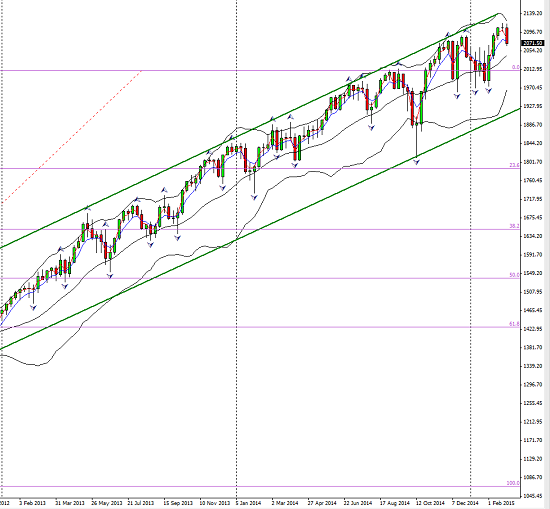
Admittedly, as the dollar strengthens, it is reasonable to expect that pressure will be brought to bear on company finances, not just from rising export prices but where the energy sector is concerned, from the inevitable impact of lower oil prices. This may be the catalyst that brings the S and P and the risk element in the market into check.
Oil
 The gyrations in the market were indeed felt elsewhere, with the commodity currencies beginning the week on an up note as the rally in oil spilt over.
Some believed, it was down to the Netanyahu speech in Washington which might have caused supply problems if the US had taken notice. As it is talk of an agreement has had quite the opposite affect.
Inventories up again, this week and the pressure showed as oil closed down on the week;

The market will be sensitive as oil bounces around in its current range but it was obvious on Friday that the the oil issues of the week were secondary as attentions and trading accounts, and I do mean the big boys , turned to the likelihood of inflation getting traction in the US.
State of play in the UK
It is by all measures the second in the rate hike race and the only other real contender and yet with the UK papers now filling up with politics and the reality of a closely run race the reaction in the market may be very uncertain and unexpected. The speculation over the possible permutations of coalitions has begun.
The EURGBP has lost more ground this week and continues to look like a sell. It is worth watching the political environment to see if that trend will continue or become less reliable.
As with all the other major pairs, the GBPUSD dropped back to the levels seen in January.
Recapping the Euro Zone
 Draghi’s upbeat speech about prospects could not mask current difficulties or the still fragile recovery, QE or not. Whether the level of QE can help save the Union from deflation remains to be seen.
There has been some improving data but disappointingly the German Manufacturing data showed a worrying miss.
The mechanics of QE are not the same as they were in the US so there can be no assumptions of success. Mr. Draghi acknowledged that he would be buying negative bonds.
On top of QE efficiency doubts, there is still the problem of Greece and that situation is far from solved.
Alan Greenspan, the former chairman of the FOMC, appearing Friday on CNBC expressed the view that the European Union cannot prevail as it is. And the prospect of fiscal union becomes more and more remote as periphery countries react to austerity measures that become increasingly difficult to sell to their voters.
The UK elections are not the only ones this summer. In France the extreme right have 33% of the vote ahead of the election, in Spain the leftist Podemus party are taking the lead in a country where unemployment is at 25% and that rises to 50% of the youth. There are also elections in Poland, Denmark, Finland, Portugal and Estonia . Unity, fiscal or otherwise seems a distant dream at this point.
The Coming Week
In the UK, Dr. Carney speaks twice, on Tuesday testimony to the House of Lords, Economic committee and on Thursday to the Manufacturing Research
Centre. Tw more opportunities to set tone ahead of the elections.
IN New Zealand, after a dramatic turn round in sentiment last week the watch will be on the rate decision. The discussion of controlling investment in what is seen as a housing bubble was interpreted as dovish so strengthening data seen of late as a possible hawkish justification was suddenly set aside. This is one to avoid until after the rate decision on Wednesday.
The usual slew of data is coming out of the US, including retail sales and employment on Thursday and consumer sentiment Friday. That will throw some light on the current rally .
In Australia employment numbers will be key following Friday’s downdraft in the currency as will numbers from China. A big week there, CPI, Trade balance and Industrial production.
USD Strength and The Risk Environment
This week is all about the sustainability and rate of the USD advance. There has been time to digest the numbers, the reactions and the catalysts ahead to stall it or spur it. We know only too well that the FOMC have trained in on specific data. We will be wise to do the same.
There has been a global lowering of rates with central bank stimulus becoming more common. The US reaching expansion first is ready to reverse the accomodative policy but in a world of yield hunting, risks have increased. The S and P and US equities are at all time highs and the US markets have been quite complacent about Fed stimulus being removed. This combined with the dollar strength impact on the economy makes it essential to watch how the equity markets will deal with the change over period that Janet Yellen is carefully attempting to manage. Shifting sentiment is a constant ‘threat’ to monitor.
Judith Waker
0 Comments